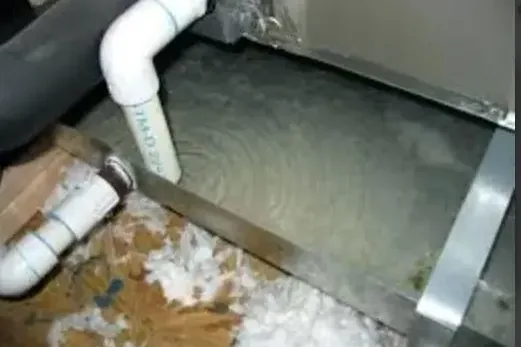
In Pinellas Park the air conditioner runs most of the year, and many air handlers sit in the attic above the ceiling. When the condensate drain clogs, the water has nowhere to go but into the ceiling below.
Key takeaways
- An air conditioner pulls humidity out of the air, and that water leaves through a condensate drain that can clog.
- A clogged drain fills the overflow pan, and then the water reaches the ceiling below.
- Switching the air conditioner off at the thermostat stops new water while the leak is dealt with.
- A sagging ceiling holds a lot of water and must be opened carefully, not poked.
- Opening the ceiling, removing wet insulation and drying the joist bays follow the same order as any ceiling leak.
How an air handler makes water
An air conditioner cools air by pulling heat and humidity out of it. The humidity turns to water on the coil, and that water is called condensate.
The condensate drips into a pan and leaves the house through a drain. In the humid subtropical climate here, an air conditioner can make a lot of it.
Where the air handler sits matters. In an attic, the pan and the drain sit directly over drywall and insulation.
A pan under the air handler catches drips. A secondary drain or a float switch can add protection, but not every system has one.
In a hot, humid climate the system can produce condensate for hours each day, which is why a partial clog can turn into an overflow.
Why condensate drains clog
Attic air handlers with condensate drains that clog are a familiar source of ceiling damage here. A clog stops the flow, the pan fills and the overflow reaches the ceiling.
A clog can form slowly, so the first sign is often the leak itself rather than any warning.
- Algae and slime grow in the damp drain over time.
- Dust and debris collect in the pan and at the drain opening.
- A drain that is bent or poorly sloped holds water in the wrong places.
- Condensate is clean at first, but it picks up dust and slime from the pan and the drain.
- A pan that rusts through can leak even when the drain works.
Signs of a condensate leak
A closet that holds an air handler shows the same signs on the floor and at the bottoms of the walls.
Stains can grow as the system keeps running, so a small mark is worth checking early.
- A brown or yellow stain on the ceiling below the air handler.
- Paint that bubbles or drywall that feels soft.
- A sagging or bulging ceiling.
- Water dripping from a light fixture or a vent.
- A musty odor, or an air conditioner that shuts off by itself.
What to do first
A professional AC leak water damage response starts with the same few steps a homeowner can take.
Running the system with a clogged drain only makes more water. A technician should check the drain before the system is restarted.
- Switch the air conditioner off at the thermostat, and at the breaker if water is near electrical parts.
- Keep people and pets out from under a sagging or bulging ceiling.
- Move furniture and valuables out of the wet area.
- Photograph the stain, the ceiling and anything that is wet.
- Do not poke or cut a sagging ceiling without help, because it can release a lot of water at once.
Opening and drying the ceiling
Once the system is off and the area is clear, the restoration team works from the ceiling down.
Large wet areas call for structural drying with a full equipment plan.
Opening the ceiling
The team cuts the wet drywall in a controlled way, removes wet attic insulation and checks the joists.
Wet attic insulation can clump and sag, which is a sign it has held water. It comes out before the joists are dried.
- Wet drywall is cut out, not left to dry, when it has sagged or stained.
- Insulation that soaked is removed because it holds water.
- Joists and the wall sections below are checked with moisture readings.
Drying the cavity
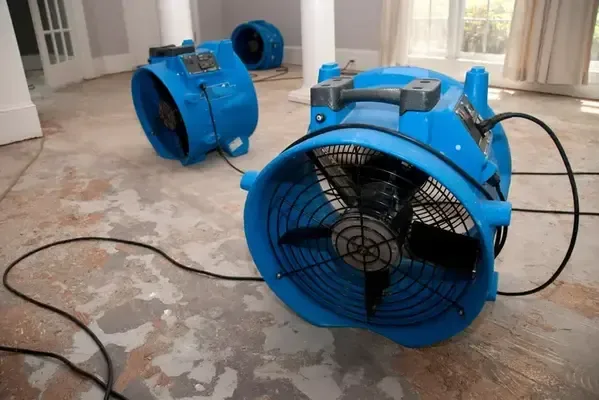
Air movers and dehumidifiers dry the joist bays and the room below. Moisture readings show when the cavity is dry, and only then is the ceiling closed.
Mold can start to grow within 24 to 48 hours on wet materials, so the work does not wait. Ceiling repairs after any leak follow the same steps as ceiling leak water damage jobs from other sources.
- Air movers push dry air through the open joist bays.
- Dehumidifiers pull moisture out of the air so the wood can release more.
- Daily readings show which areas are ready to close.
When the leak reaches the floor
Water that runs down a wall or through a closet ceiling can end up on the floor below. Standing water is removed first, and water extraction handles carpet, pad and floors before the structural drying starts.
Carpet and pad soak up water quickly, and they come out as part of the cleanup. Hard floors are dried in place when they can be.
Keeping the drain from clogging again
The air conditioner technician fixes the cause, and the restoration team removes the damage the leak already caused. The two jobs go in that order.
- Have the technician clear the drain and check the pan.
- Ask whether a float switch can be added to shut the system off when the pan fills.
- Check the drain outlet outside for flow during hot weather.
- Look at the ceiling under the air handler when the system has been running hard.
Questions
Why does an air conditioner leak water into the ceiling?
The air handler produces condensate as it removes humidity. When the drain clogs, the pan fills and the water overflows onto the drywall and insulation below.
Should the air conditioner stay on during a leak?
No. Turn it off at the thermostat so it stops making condensate, and at the breaker if water is near electrical parts. Then have the drain cleared before the system is used again.
Can a stained ceiling be painted over?
Not safely. A stain means the drywall and insulation got wet, so they need to be opened, dried and checked first. Painting over a wet ceiling hides the problem and holds moisture inside.
Is the water from an air handler contaminated?
It starts as clean water, but it picks up dust and slime from the pan and the drain. Wet materials are dried or removed depending on how long they stayed wet.
How long does a ceiling take to dry?
It depends on how much water reached it and how long it stayed wet. Moisture readings in the joists and drywall decide when the equipment comes out.
Can a clogged condensate drain be cleared at home?
Some homeowners try clearing the drain, but a technician should check the pan, the slope and any safety switch. Clearing the drain is not the same as finding out why it clogged.